
News / 5 July 2026
Weekly Review: U.S. Labour Market Cools
U.S. job growth slowed sharply in June, with nonfarm payrolls increasing by 57,000, well below expectations of 110,000. Payroll figures for April and May were also revised down by a combined 74,000, reinforcing signs of a cooling labour market. Although the unemployment rate edged down to 4.2%, the decline was largely driven by lower labour force participation rather than stronger hiring. The softer labour market led markets to scale back expectations for a September interest rate hike, while continuing to price in no change at the Federal Reserve’s July meeting.
Separately, the Institute for Supply Management (ISM) reported that its Manufacturing Purchasing Managers’ Index (PMI) eased to 53.3 in June from 54.0 in May, below market expectations. Despite the decline, the index remained above the 50-point mark for a sixth consecutive month, signalling continued expansion in manufacturing activity. While new orders and production moderated, the sharp decline in the prices paid index pointed to easing cost pressures.
EUROPE & UK
According to Eurostat, annual eurozone inflation eased to 2.8% in June from 3.2% in May, below market expectations. Lower oil prices helped moderate inflationary pressures, while core inflation, which excludes volatile food and energy prices, slowed to 2.4%. Services inflation, a closely watched gauge of underlying inflationary pressures, also eased to 3.2% from 3.5%. Although inflation remains above the ECB’s 2% target, ECB President Christine Lagarde said the central bank no longer needs to respond to inflation with the same force as during the 2022-23 inflation shock. Meanwhile, the Office for National Statistics confirmed that the UK economy expanded by 0.6% in the first quarter of 2026, in line with previous estimates. Growth was driven by the services sector, although real household disposable income declined by 0.8%, highlighting continued pressure on household finances.
ASIA
The Japanese yen remained volatile, weakening to around JPY 162.5 per U.S. dollar, its weakest level in nearly 40 years, before rebounding on speculation that Japanese authorities could intervene in the foreign exchange market. The yen continues to face pressure from the wide U.S.-Japan interest rate differential, alongside concerns over Japan’s fiscal position and higher energy prices. China’s June PMI data pointed to continued resilience in the manufacturing sector despite broader economic headwinds. The official Manufacturing PMI rose to 50.3 from 50.0 in May, supported by stronger production, new orders and high-tech manufacturing, while the Non-Manufacturing PMI edged up to 50.2. The private RatingDog Manufacturing PMI eased marginally to 51.7 from 51.8, remaining in expansionary territory. Overall, the data highlighted an uneven recovery, with high-tech manufacturing continuing to outperform more domestic demand-sensitive sectors.
GLOBAL EQUITIES
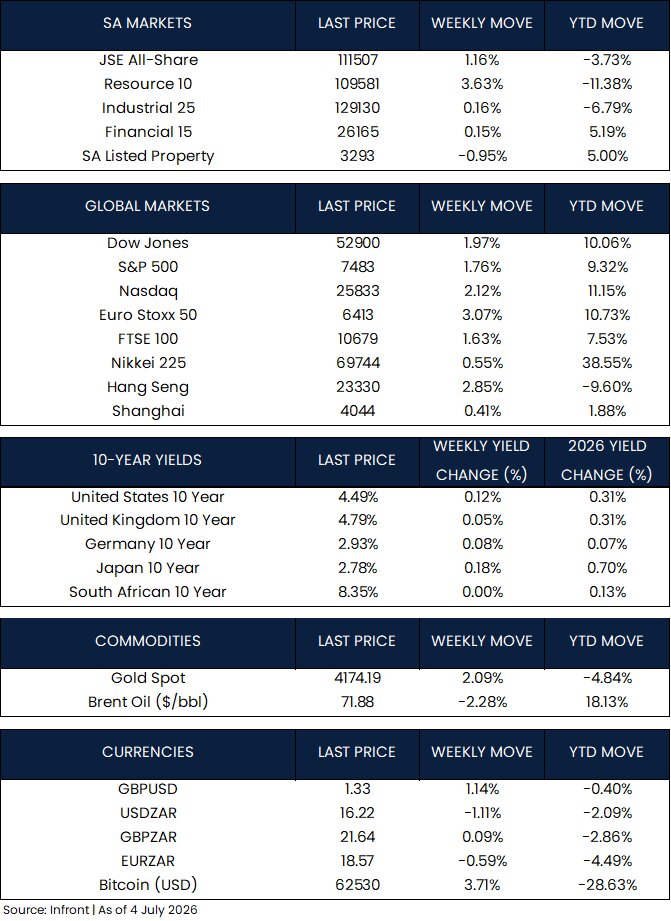
Global equity markets ended the week higher as easing geopolitical tensions, lower oil prices and resilient economic data supported investor sentiment. U.S. equity markets ended the holiday-shortened week higher, with the Nasdaq Composite gaining 2.12%, the Dow Jones Industrial Average rising 1.97% and the S&P 500 advancing 1.76%. European equities also posted solid gains, with the STOXX Europe 50 Index rising 3.07% as lower oil prices and easing inflationary pressures supported sentiment, while the UK’s FTSE 100 added 1.63%. In Japan, the Nikkei 225 rose 0.55% over the week, rebounding sharply on Friday after earlier losses driven by profit-taking in technology and semiconductor stocks. In China, the Shanghai Composite Index gained 0.41%, while Hong Kong’s Hang Seng Index rose 2.85%, supported by better-than-expected manufacturing data and improved short-term liquidity conditions.
Market Moves of the Week:
South Africa’s manufacturing sector lost momentum in June, with the Absa Manufacturing PMI falling to 47.3 from 50.8 in May, signalling a return to contraction. Weaker demand weighed on new orders, although some businesses reported customers delaying purchases in anticipation of lower prices following recent fuel price cuts. In contrast, the S&P Global PMI rose to 50.5 from 49.6, suggesting broader private sector activity remained resilient.
Local equity markets strengthened over the week, mirroring global market trends. The JSE All Share Index rose 1.16%, driven by a strong recovery in resource stocks, which gained 3.63%. Industrials (+0.16%) and financials (+0.15%) were broadly flat, while listed property was the only sector to decline, falling 0.95%. The rand strengthened against the U.S. dollar, ending the week at R16.22/$.
Chart of the Week:
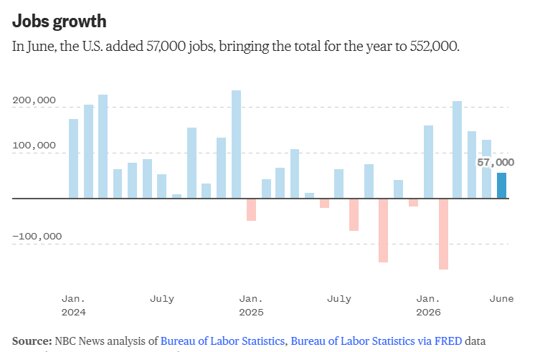
U.S. job growth slowed sharply in June, with the economy adding just 57,000 jobs and bringing the total for the year to 552,000. The chart shows how monthly hiring has cooled through 2026, with several recent months revised into negative territory, reinforcing signs of a softening labour market and supporting expectations for a less aggressive monetary policy tightening cycle. Source: NBC News analysis of Bureau of Labor Statistics data
Credits: Strategiq Capital