

News / 12 October 2025
Week in Review: Trade Tensions & Shutdown Weigh on Markets
European data signalled continued weakness, led by a 4.3% drop in German industrial production in August, driven by auto sector declines and broader softness across manufacturing. Exports also fell, particularly to the U.S., prompting the German government to introduce budget cuts and electric vehicle subsidies. Political instability added pressure as the resignation of France’s prime minister triggered a selloff in French assets and higher bond yields. In the UK, house prices declined and buyer demand remained weak, although business activity stabilised slightly. The ECB noted inflation is moving closer to target and growth may recover in 2026, though sluggish exports and a stronger euro could limit near-term momentum.
Japanese equities rose early in the week after Sanae Takaichi secured leadership of the ruling LDP, increasing expectations for fiscal stimulus and continued loose monetary policy, which weakened the yen. However, optimism faded as coalition partner Komeito withdrew support, raising uncertainty over government formation and fuelling speculation of a snap election. The 10-year JGB yield climbed to its highest level since 2008 on expectations of additional stimulus. Economic data was mixed, with wage growth slowing but household spending and producer price inflation both remaining firm, pointing to underlying demand despite political uncertainty.
Global markets were mixed. In the U.S., the Dow fell 2.73%, the S&P 500 lost 2.43% and the Nasdaq declined 2.53%. In Europe, the Euro Stoxx 50 fell 2.13% and the FTSE 100 slipped 0.67%. In Asia, Japan’s Nikkei 225 rose 5.07%, the Shanghai Composite edged up 0.37% and Hong Kong’s Hang Seng dropped 3.06%. U.S. 10-year Treasury yields moved lower on safe-haven demand, while German and UK yields also declined slightly and Japanese yields rose. Gold strengthened and oil prices fell, while Bitcoin declined but remains higher year to date.
Market Moves of the Week
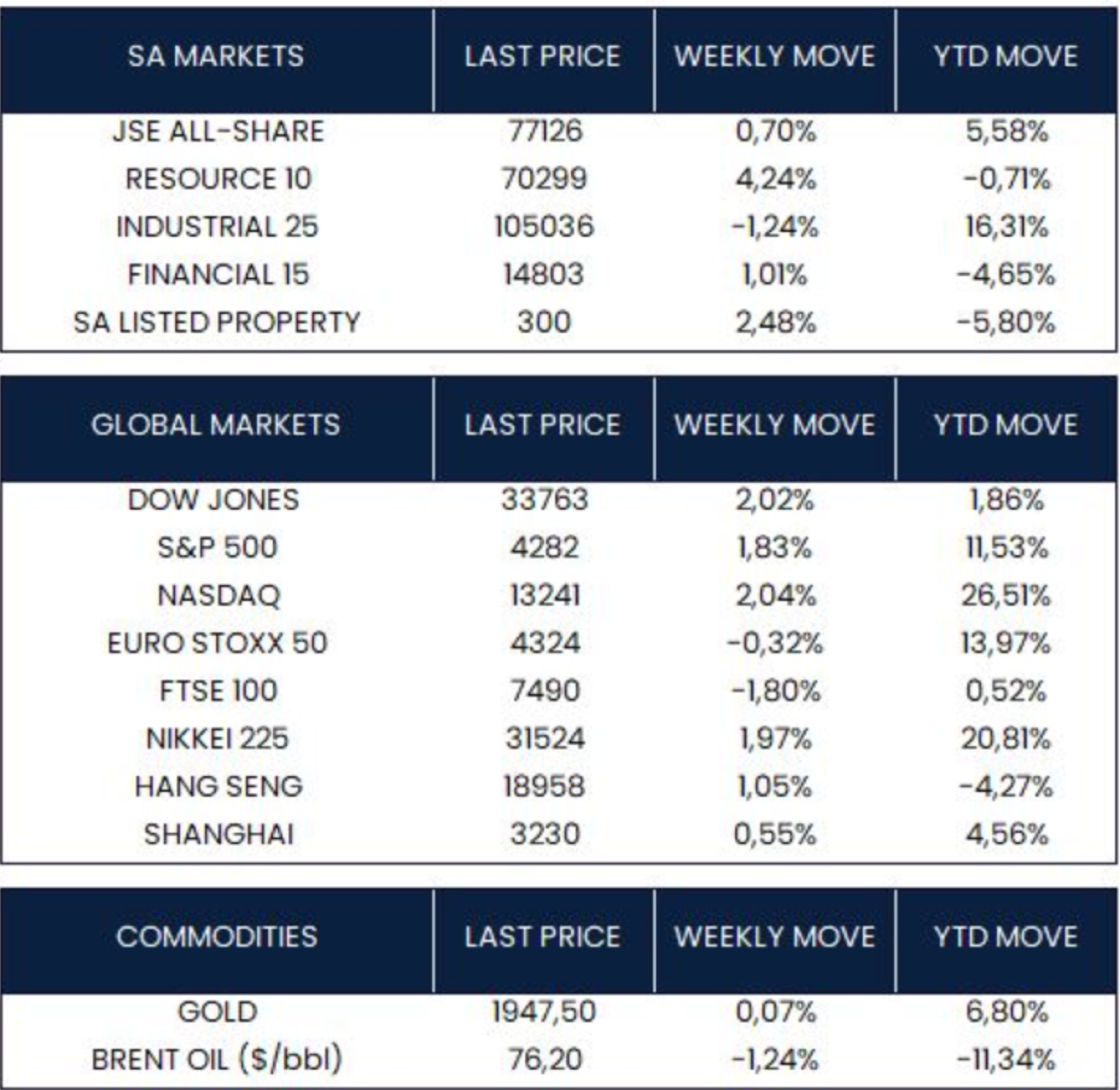
South African markets were mixed over the week. The JSE All Share Index inched up 0.22%, supported by financials (+3.80%) and listed property (+2.48%). Resource stocks fell 1.40% and industrials declined 1.37%, weighing on overall gains. The rand weakened 1.61% against the U.S. dollar to R17.49 as global risk sentiment softened, while the South African 10-year government bond yield was little changed at 9.14%.
Chart of the Week:
Politics doesn’t matter to markets, until it does. France’s prime minister resigned after failing to form a stable cabinet, highlighting deep divisions over how to manage the country’s heavy debt burden. With no agreement on fiscal policy, confidence in French bonds deteriorated sharply, pushing yields higher than Italian bonds for the first time since the euro’s launch in 1999. France has had five prime ministers in under two years - matching Italy’s historical total of 45 since World War II (The equivalent for the UK is 19) -underscoring escalating instability. Investors have responded by selling French assets, and despite French companies being largely global, the CAC 40 has underperformed the rest of Europe by about 14% since the start of last year. Source: Bloomberg Credits: Strategiq